Cyber Epitaph: A Time Capsule for the Future
How an ordinary human uses technology to fight oblivion
[This article contains AI-assisted creation]
Last year, I visited a rather special exhibition at a museum: it was about the documents of Xu Weili, a Song Dynasty official.
Xu Weili was an ordinary official in the mid-Southern Song period, who died in 1254. When his tomb was discovered in the early 21st century, his coffin contained not only his skeletal remains but also a complete set of “Gao Shen” (appointment documents) and other papers. These were essentially his appointment letters and curriculum vitae. These papers had been buried underground for over seven hundred years, yet they could still be carefully unfolded and read today. The ink was distinct, and the official seals remained intact.
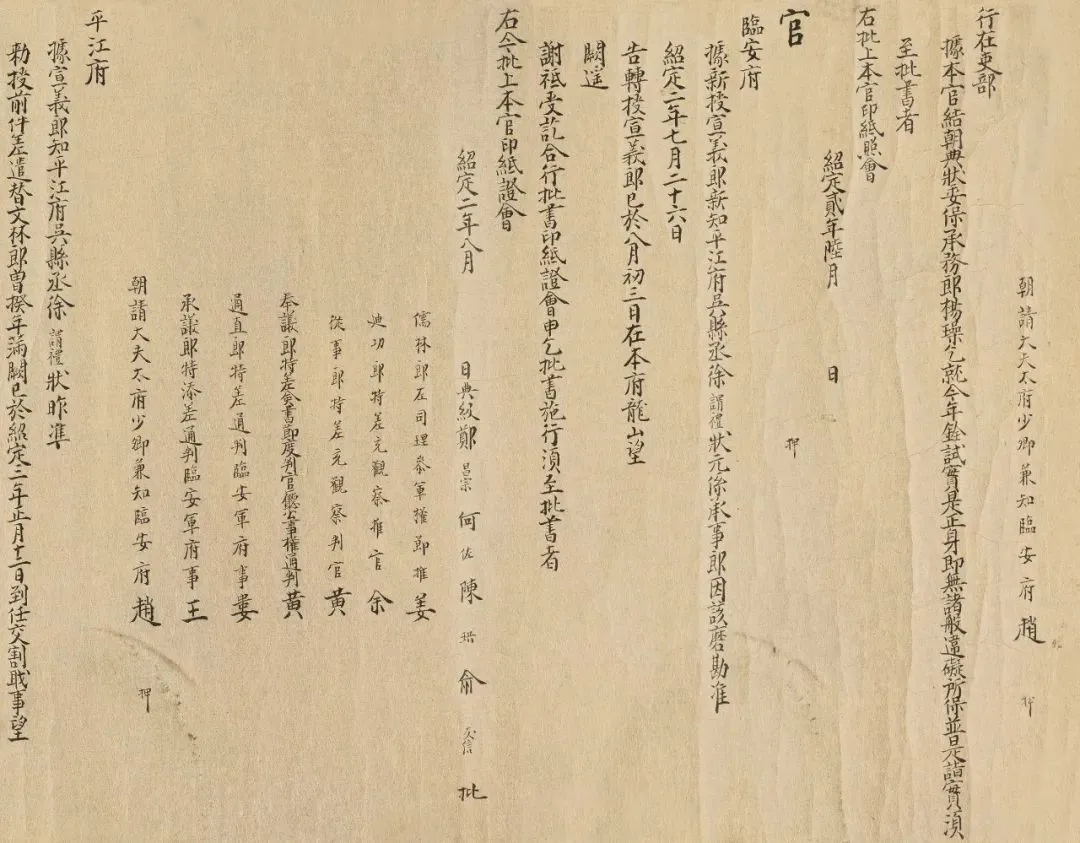
Xu Weili Documents
These documents recorded the trajectory of his entire career: from a low-level clerk to a local official. Every promotion, every post location, and every appointment decree issued by the imperial court was preserved one by one. This is the only set of physical archives found to date that presents the complete official career of a Song Dynasty civil servant, making it crucial material for studying the ancient Chinese civil service system.
However, what touched me most was not its historiographical value, but a more personal thought: over seven hundred years ago, Xu Weili (or his family) made a decision—to place these documents recording his life’s work into the coffin to be buried with him. To others, these papers were just procedures and official documents, not precious gold or jewelry, nor exquisite art; but to him, they were the proof of his existence, the traces of his lifelong struggles, efforts, promotions, and setbacks.
Judging by the result, he succeeded. Centuries later, through these slightly fragile but still clear papers, we know his name, we know the path of his career, and we know that such an ordinary Southern Song official actually lived.
When I returned home and stood before my hard drive enclosure, watching those blinking indicator lights, I suddenly realized: our generation might be the first humans who need to seriously consider “Digital Heritage.” Not the social media passwords left for grandchildren, but information carriers in the true physical sense, capable of traversing time or even civilization gaps.
If one day my physical body turns to dust, in what form should the bitstreams recording my thoughts, creative fragments, and emotional memories be buried with me?
The First Dilemma: Physical Decay of Media
Over the weekend, I went to the electronics market and stared at the dazzling array of storage devices in the display cases for a long time. The shop owner thought I wanted to buy something and enthusiastically introduced a product: “This flash drive has fast read/write speeds, 500MB/s!” I shook my head and asked a question that stunned him: “Which storage medium can last for a thousand years?”
The USB flash drive, a small object we carry around and take for granted, is actually the most fragile choice. It uses NAND Flash technology—etching billions of tiny transistors on a silicon substrate, each containing a floating gate wrapped in an oxide layer. Data is stored in this floating gate: when a high voltage is applied by the control circuit, electrons pass through the oxide layer via the quantum tunneling effect and accumulate in the floating gate, writing a “1”; no electron accumulation is a “0”.
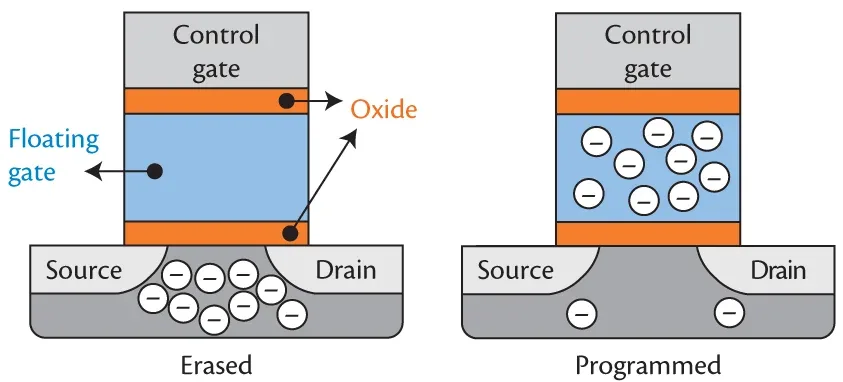
SSD Data Storage Principle
The problem lies with the concept of “eternity.” The electrons in the floating gate are not locked away forever. They gradually leak back due to microscopic defects in the oxide layer, thermal motion, and quantum effects. In physics, this process is called “Charge Retention Degradation.” At a standard room temperature of 25°C, the data retention time for consumer-grade TLC (Triple-Level Cell) flash memory is only about 1 year. SLC (Single-Level Cell) is slightly better, reaching 10 years. If the temperature rises to 40°C, this time is cut in half.
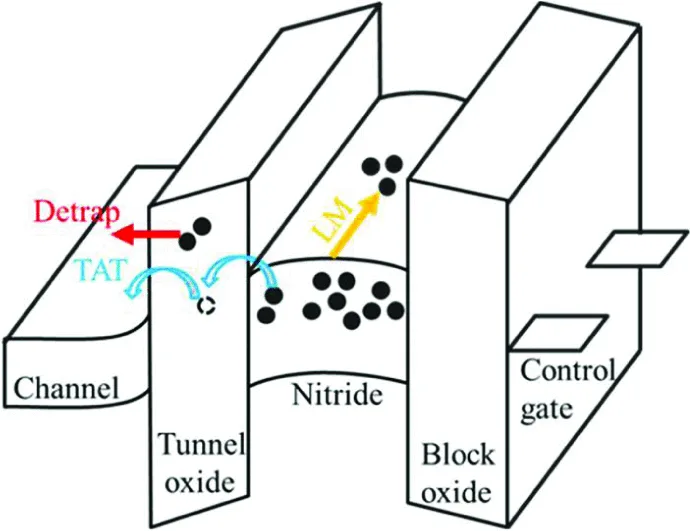
“Investigation of Retention Characteristics in a Triple-level Charge Trap Flash Memory” - Research on long-term data retention characteristics, including three main charge loss mechanisms: detrap, trap-assisted tunneling (TAT), and lateral charge loss.
Even more terrifying is the limit on write cycles. Each erase/write operation causes microscopic damage to the oxide layer via high voltage. Accumulated damage eventually causes the cell to fail. The write limit for SLC is about 100,000 cycles, MLC is 10,000, TLC is only 3,000, and the latest QLC is merely 1,000.
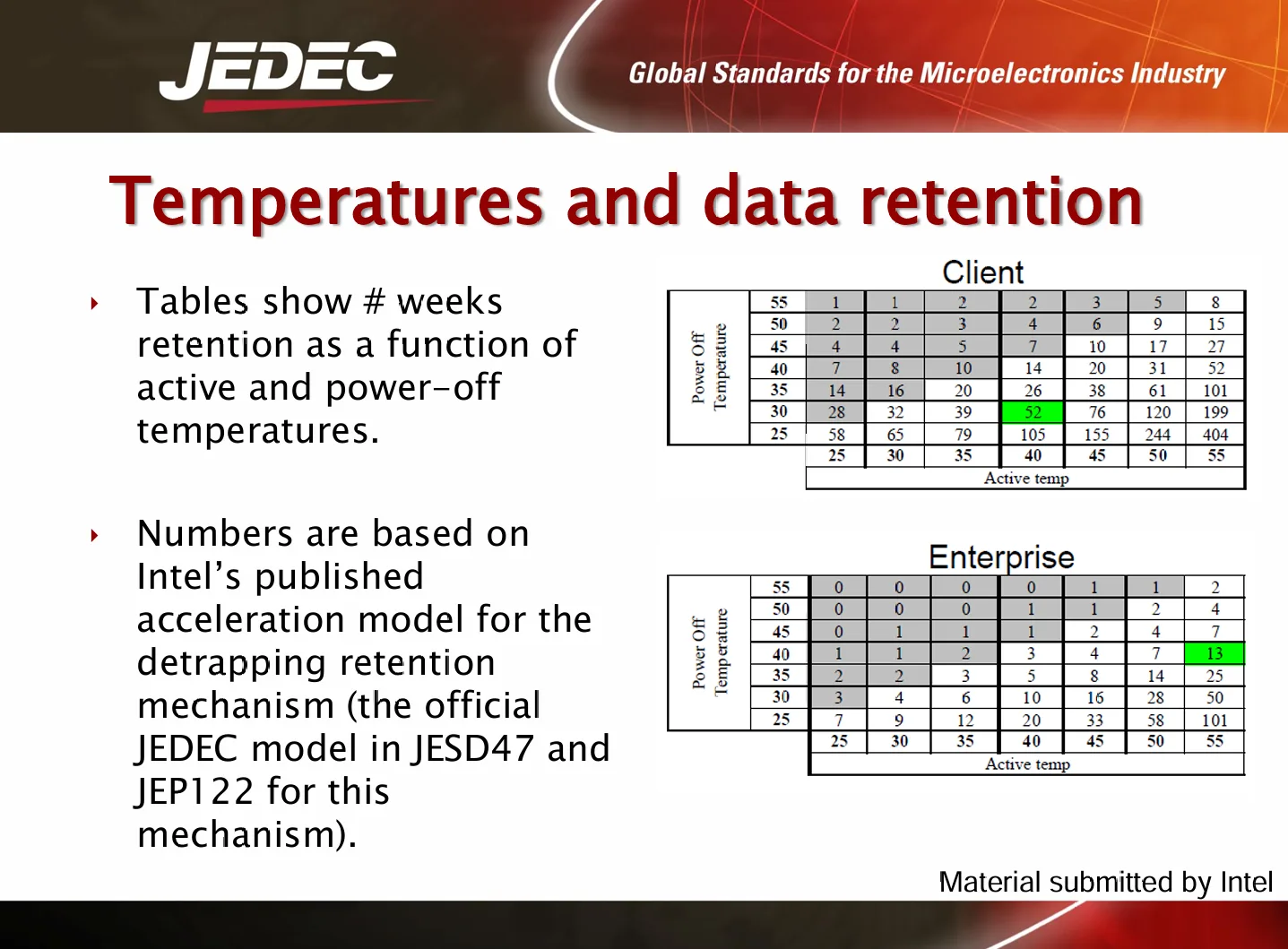
If left unpowered for a long time, the situation gets worse. I found data presented by Alvin Cox, Chairman of the JEDEC Solid State Technology Association, at a 2015 meeting. It contained a disturbing table: For consumer SSDs under a 40°C operating temperature and 30°C storage temperature, data remains intact for a year after power loss; but if the storage temperature rises to 55°C, data could begin to fail within a week in the worst-case scenario. Enterprise SSDs are even more severe—operating at 40°C and stored at 25°C, they only retain data for 20 weeks after power loss, and in extreme cases, data could be corrupted within 7 days. This means if you put a well-used USB drive in a coffin hoping it can be read ten years later, you will likely only get a pile of corrupted files.
Mechanical hard drives (HDDs) are slightly more complex. I once disassembled a scrapped Western Digital hard drive; the precision structure was breathtaking. Aluminum alloy or glass substrates are plated with nanometer-level cobalt-chromium alloy magnetic layers, and the read/write heads float 3 to 5 nanometers above the disk surface—closer than one ten-thousandth of a human hair. This gap cannot tolerate even a speck of dust, so the interior of the hard drive is a near-vacuum clean environment. Modern helium-filled drives seal helium inside the chassis to reduce air resistance and oxidation.
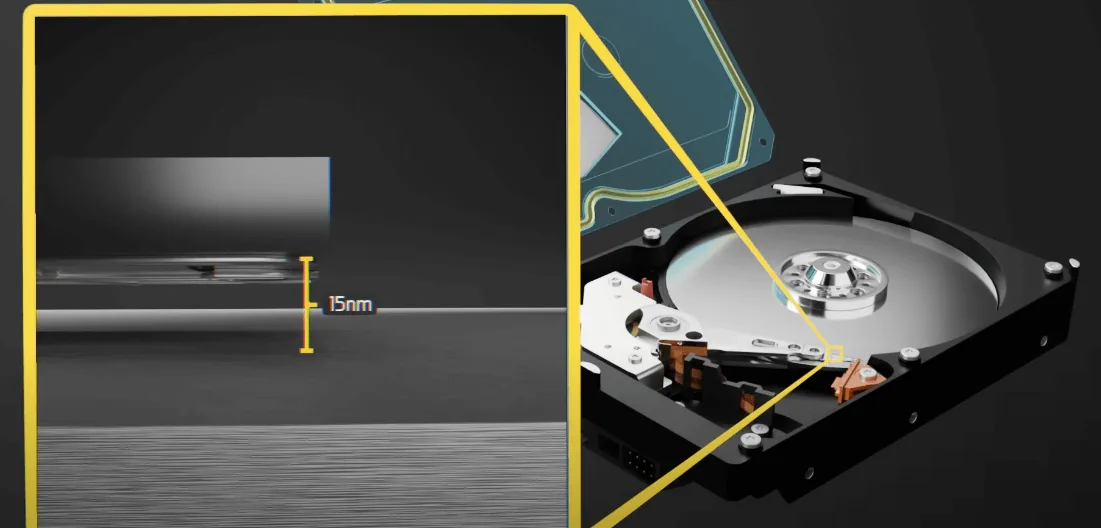
Data is stored in the form of magnetic domains—imagine countless tiny magnets on the surface of the magnetic material, where the orientation of their N and S poles represents 0 and 1. When writing data, the magnetic field generated by the head forcibly flips the direction of these domains. But magnetism is not eternal. At room temperature, magnetic domains undergo spontaneous magnetization reversal due to thermal motion, a phenomenon called “Superparamagnetism.” The smaller the magnetic domain (i.e., the higher the storage density), the more obvious the impact of thermal fluctuations.
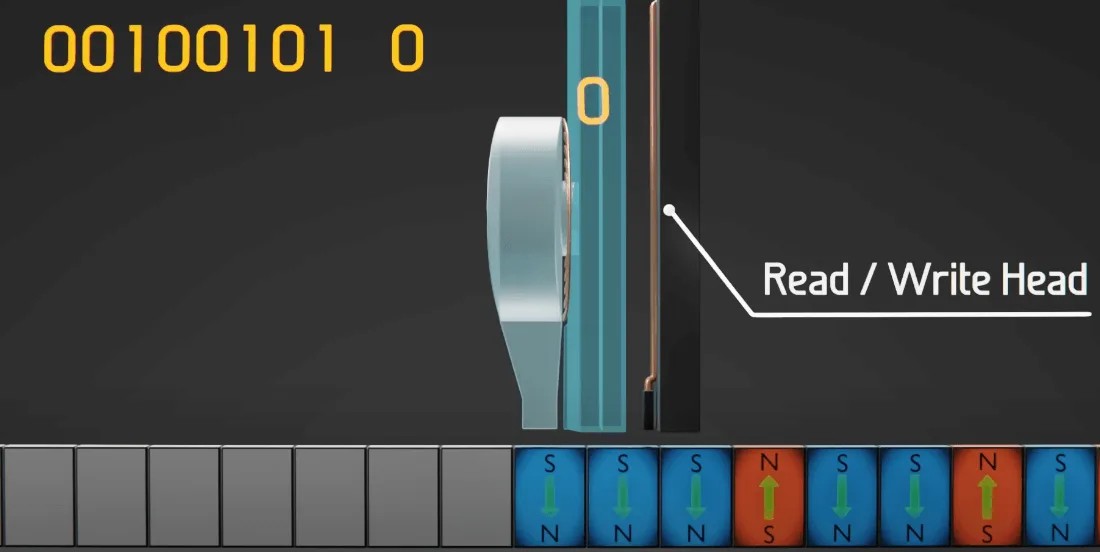
Current PMR (Perpendicular Magnetic Recording) technology has pushed storage density to the theoretical limit of 1TB per square inch. Individual magnetic particle sizes are only about 10 nanometers. At this scale, room temperature thermal energy is enough to cause spontaneous demagnetization of domains over long-term storage. Western Digital’s enterprise hard drives claim an MTBF (Mean Time Between Failures) of 2 million hours, but annual reports from Backblaze show that in actual use, the annual failure rate of hard drives is between 1.3% and 2%. The overall AFR in 2024 was 1.57%, with some problematic models reaching 5-6%. The cumulative failure rate after three years would be even higher.
The Second Dilemma: Material Science of Optical Media
DVDs and Blu-ray discs were once considered synonymous with “permanent storage.” I have a collection of optical discs burned over a decade ago. I took them out recently to read them, only to find that one-third were unrecognizable. The surface of the disc looked intact, but once inside the drive, I could only hear the futile sound of the laser head seeking tracks.
The structure of an optical disc is more complex than it looks. Taking a Blu-ray disc as an example, from bottom to top: polycarbonate substrate, recording layer, dielectric layer, reflective layer, and protective layer. Data is stored in the recording layer—for recordable discs (BD-R), this layer is organic dye. Common types include Phthalocyanine, Azo, and Cyanine dyes. During burning, a 405nm blue-violet laser focuses on the dye layer, and high heat causes an irreversible chemical change in the dye, turning it from transparent to opaque, forming an alternating arrangement of “pits” and “lands.”
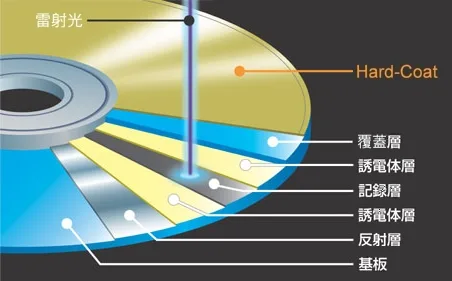
The problem is that organic dyes degrade. Ultraviolet light destroys the chemical bonds of dye molecules, oxygen oxidizes them, moisture hydrolyzes the polycarbonate substrate, temperature changes cause expansion and contraction, and adhesives between layers age. ISO tests indicate that under ideal conditions of 25°C and 50% relative humidity, high-quality BD-R discs can last 30 to 50 years.
Then I discovered the M-DISC (Millennial Disc). This technology was developed by Brigham Young University in 2009 and later commercialized. Its revolutionary aspect lies in abandoning organic dyes for inorganic materials—mainly carbonate compounds, chemically stable like rock. Burning requires higher laser power, about 3 to 5 times that of ordinary Blu-ray discs. The laser essentially physically etches the material rather than chemically altering it.
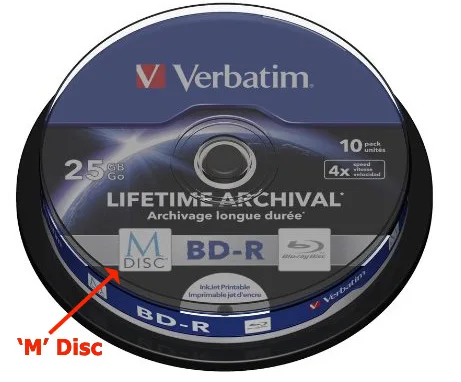
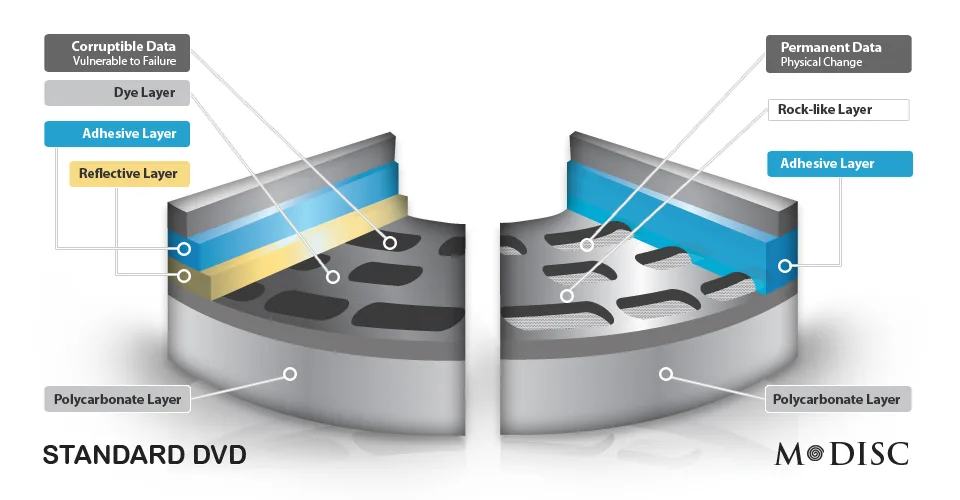
M-DISC actual product and difference from ordinary DVD
I bought a Pioneer BDR-XD08 that supports M-DISC burning, along with a box of Verbatim M-DISC Blu-ray discs. It took nearly 3 hours to burn 100GB of data, significantly slower than ordinary discs. But after burning, I observed the disc surface with a microscope. The pits etched by the laser had clear, sharp edges, completely different from the blurred boundaries of dye-based discs.
The US Department of Defense’s research agency, NIST (National Institute of Standards and Technology), conducted accelerated aging tests on M-DISC. They placed the discs in an environment of 85°C and 85% relative humidity—equivalent to decades of aging in a natural environment. Ordinary DVD-Rs failed within weeks under these conditions, while M-DISC remained intact after more than a month, with no significant increase in error rates. According to the Arrhenius equation extrapolation, under normal temperature and humidity, the theoretical life of M-DISC can reach 1,000 years.
Of course, this “1,000 years” has many prerequisites. First, the polycarbonate substrate itself also ages. Although much slower than dye, on a scale of centuries, the breaking of molecular chains, changes in crystallinity, and decline in mechanical strength of the plastic are unavoidable. Second, the issue of reading devices: will there be devices capable of reading Blu-ray discs in 1,000 years?
Just as I was worrying about the plastic substrate, I found “Project Silica” being developed by Microsoft—a truly “eternal storage” project.
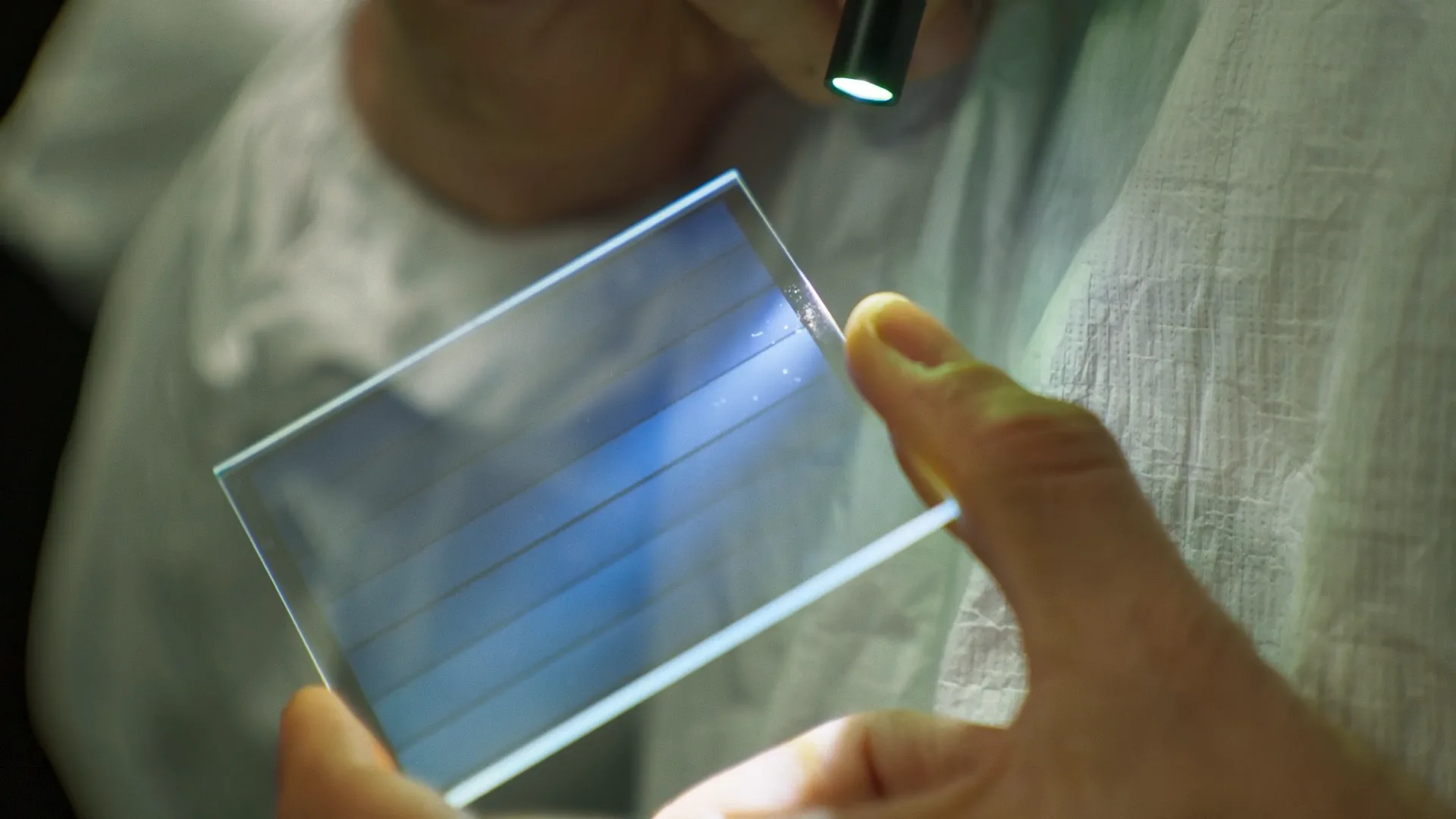
Microsoft Project Silica
Project Silica uses pure quartz glass as the storage medium. Not surface etching, but using femtosecond lasers to create tiny optical structures within the three-dimensional space of the glass—each “voxel” (3D pixel) is only a few microns in size. By changing the power and polarization of the laser, multiple bits can be encoded at the same location. Data is stored as permanent changes in the refractive index and birefringence inside the glass.
This is not a chemical reaction, but a change in physical structure. Quartz glass is practically inert on a geological scale—natural quartz crystals can exist stably in the earth’s crust for billions of years. Microsoft’s tests show that Project Silica’s glass slides maintain data integrity even at high temperatures of 190°C. Based on extrapolation, the life of this storage medium at room temperature could exceed 10,000 years, or even longer.
In 2019, Microsoft successfully stored the entire “Superman” movie (75.6GB) on a 10cm x 10cm x 2mm piece of quartz glass. Reading uses a polarized light microscope and machine learning algorithms—a laser beam scans the interior of the glass, detects the birefringence characteristics of each voxel, and then decodes it into digital information.
But the problem is that this technology is still in the laboratory stage, commercialization is far off, and individuals cannot access it. Moreover, the reading equipment is extremely complex—requiring precise optical systems and specialized decoding algorithms. If a future civilization loses these technologies, even if the glass slide is intact, the data inside cannot be read.
This led me to a thought: the most advanced technology is not necessarily the most reliable solution. What can truly traverse time might be those simple, intuitive storage methods that can be understood with basic technology.
The Third Dilemma: Error Correction Codes and Redundancy Design
Assuming I have selected M-DISC as the core storage medium, the next question is: how to deal with inevitable local damage?
The enemies of optical discs are everywhere. Scratches, fingerprints, mold, disc deformation—any factor can lead to read errors. Fortunately, optical discs considered this problem from the beginning. CD uses CIRC (Cross-Interleaved Reed-Solomon Code), DVD uses RS-PC (Reed-Solomon Product Code), and Blu-ray uses a combination of LDC (Long Distance Code) and BIS (Burst Indication Subcode).
Reed-Solomon code is a powerful algebraic error correction code invented by MIT mathematicians in the 1960s. Its principle is based on polynomial operations on finite fields (Galois Field). Simply put, assuming you want to store k data symbols, the encoder generates n symbols (n > k), where the extra n-k symbols are “parity symbols.” The decoder can tolerate up to (n-k)/2 symbol errors.
For Blu-ray discs, each error correction unit contains 248 bytes, of which 216 bytes are data and 32 bytes are parity codes. This means it can theoretically correct 16 bytes of errors. But this assumes errors are randomly distributed. In reality, disc damage is often “burst errors”—a scratch might destroy several hundred consecutive bytes.
This is where “Interleaving” technology comes into play. Before encoding, data is rearranged so that originally adjacent bytes are scattered to different locations. Thus, even if an area is completely damaged, upon decoding and de-interleaving, the damage is dispersed across multiple error correction units, each suffering only minor impact, allowing the Reed-Solomon code to repair it.
But this is not enough. The error correction capability of commercial optical discs is fixed; you cannot adjust it. If I want to store truly important data, I need a more aggressive redundancy scheme.
This is where PAR2 (Parity Archive 2) technology comes in. This is a file-level error correction tool, originally designed for reliable transmission on Usenet newsgroups. PAR2 works similarly to Reed-Solomon but operates on entire file blocks.
I conducted an experiment. I packed 1GB of photos into a zip file, then used the par2cmdline tool to generate recovery volumes with 30% redundancy:
par2 create -r30 -n100 photos.zipThis generates 100 small files, totaling about 300MB. The key is, even if the original archive is damaged by 50%, as long as I can find enough recovery volumes, I can fully reconstruct the data.
I tested an extreme case: deliberately sanding the disc surface with sandpaper, causing about 1% of sectors to be unreadable. Direct reading of the original file failed to unzip. But running PAR2 repair:
par2 repair photos.zip.par2The program scanned all available files and recovery volumes, calculated the missing parts, and after ten minutes or so, the complete photos.zip was reconstructed, with an MD5 checksum that matched perfectly.
This gave me confidence. My plan is:
- Main Dataset: Burned onto 3 M-DISC BD-R XL (100GB) discs, totaling 300GB.
- First Layer of Redundancy: Generate 30% PAR2 recovery volumes for each disc, burned onto a 4th disc.
- Second Layer of Redundancy: Burn a complete backup of the most critical data (selected photos, core documents).
A total of 5 to 6 discs can accommodate my most important digital life.
The Fourth Dilemma: Self-Explanatory Formats
Now assume my discs are perfectly preserved for 500 years. Future archaeologists (or a curious descendant, or alien life) dig up my tomb and discover these discs. Can they read them?
This is a layered problem. First is the physical layer—they need to realize this thin disc is an information carrier. The spiral track structure of the disc is obvious under a microscope, and the alternating arrangement of pits and lands is clearly artificial coding. But how to read it?
I decided to burn an extra “Lead-in Area” on the inner ring of each disc, using the simplest encoding to store a reading guide:
- Laser Wavelength: Use a series of gradient grating patterns to imply the optimal reading wavelength is between 380nm and 420nm (blue-violet light).
- Reading Speed: Use the change in spiral spacing to indicate the linear velocity should be 4.92 m/s (standard 1x Blu-ray speed).
- Decoding Method: Use diagrams to represent 17PP modulation (the channel coding method for Blu-ray discs).
More importantly, the logical layer. File systems might be black boxes to future civilizations. NTFS, exFAT, UDF are highly complex data structures. I need a more direct solution.
I wrote a Python script to create a “Raw Data” image file. No complex file system, just a raw stream of bytes, arranged in a fixed format:
[Magic Header: 8 bytes] [Version: 4 bytes] [Block Count: 8 bytes]
[Data Block 1: Header + Content] [Data Block 2: Header + Content] ...
Each data block contains:
[Type: 4 bytes] [Length: 8 bytes] [Checksum: 32 bytes] [Content: N bytes]The Type field defines the content format: 0x01 for uncompressed bitmap images, 0x02 for UTF-8 text, 0x03 for WAV audio, 0x04 for raw RGB video frames. I deliberately avoided any format requiring complex decoding—no JPEG, no MP4, no zip files. All photos are converted to PNG or uncompressed BMP, and all videos to frame-by-frame RGB sequences. Yes, this vastly increases storage space requirements, but it maximizes interpretability.
At the very beginning of the disc, I placed a “Rosetta Stone”—a self-contained tutorial using images and minimal text to explain how to decode the subsequent data:
Page 1: Demonstrates the concept of binary. A black and white checkerboard, where each square is either pure black (0) or pure white (1), with a dot matrix beside it representing the same pattern, and below the dot matrix are the corresponding binary numbers.
Page 2: Explains the Byte. 8 binary bits in a row, grouped by different colors, showing how to combine bits into bytes, and the correspondence between decimal and binary (0 to 255).
Page 3: ASCII Table. A complete table with byte values (hexadecimal) in the left column and corresponding characters in the right. From spaces, numbers, upper/lowercase letters, punctuation, to control characters. Each character is displayed in a large font for easy identification.
Page 4: Basic Geometric Shapes. Circle, triangle, square. Below each shape, pixel coordinate methods are noted, explaining the scan order of bitmaps (left to right, top to bottom).
Page 5: RGB Color Space. A cube with three axes representing Red, Green, and Blue. Corners are marked (0,0,0) Black, (255,255,255) White, and pure Red, Green, Blue. A rainbow gradient map demonstrates color mixing.
Pages 6-10: Progressively complex images—human hands (various gestures), faces (different expressions), then my own photo, the city I live in, my home. Each image comes with a brief text description (in ASCII encoded English and Chinese), but the images themselves are self-explanatory.
This design borrows from the plaques on the Pioneer 10 and 11 probes launched in 1972 and 1973, and the Golden Record carried by Voyager in 1977. Carl Sagan’s team faced the exact same problem I do: how to convey information to a completely alien intelligence?
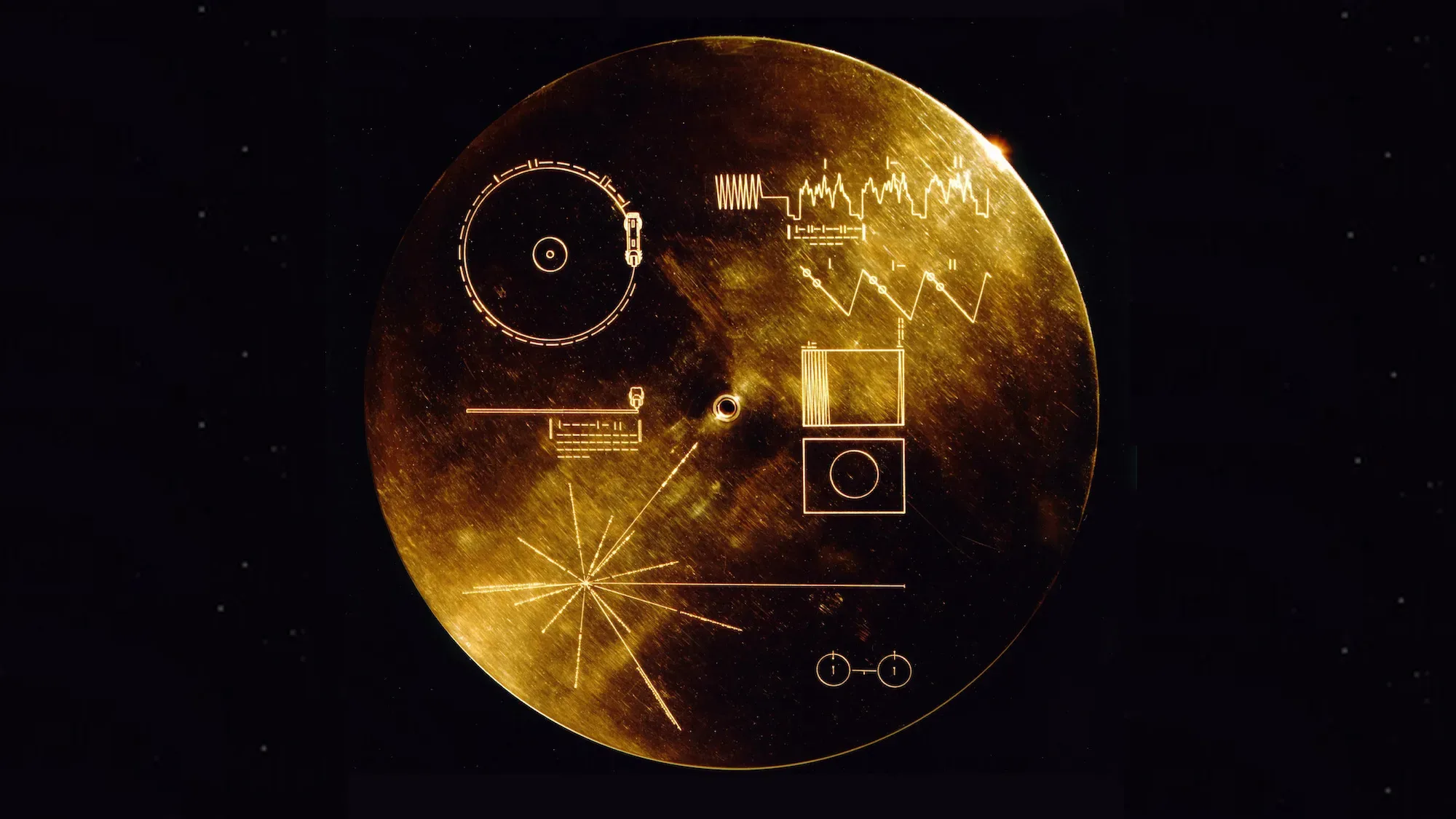
Voyager Golden Record
The cover of the Voyager Golden Record is a masterpiece. The top left depicts how to play the record—a side view of a stylus contacting the record surface, noting the correct rotation speed in binary. The top right is a pulsar map, using 14 rays to represent the sun’s position relative to 14 pulsars, with binary numbers marking the period of each pulsar (using the hyperfine transition frequency of hydrogen as the time unit).
I cannot etch a pulsar map of equal precision onto an optical disc, but I can store current photos of the starry sky. I used Stellarium software to generate a star map of the Northern Hemisphere for January 6, 2026, marking the position, brightness, and spectral type of major stars. I also included data on the precession of the Earth’s rotational axis—the axis rotates around the ecliptic pole once every 26,000 years, making it a reliable “timestamp.” If future decoders understand astronomy, they can deduce the era the disc was created by comparing the star field then to my records, with an error of no more than a few hundred years.
The Fifth Dilemma: Nested Personal Information
I am not saving the entirety of human knowledge, just the traces of existence of the individual “me.”
I selected 300 photos covering key moments in my life: childhood, education, work, travel, important people, important places. Each photo comes with metadata: shooting time, geographic coordinates, and a record of my mood at the time.
I saved everything I have written: blog posts, diaries, unfinished novels, work notes, letters to friends. These texts record the trajectory of my thoughts, how I view the world, and my confusion and epiphanies at different stages.
I saved the code I created: from “Hello World” when I first started learning to later complex projects. Each project comes with a README file explaining what problem it solves and why I think it is important.
I saved my voice: I recorded a self-introduction, stored in WAV format—48kHz sample rate, 16-bit depth, stereo, uncompressed. In the calmest tone, I recount who I am, what kind of era I live in, and how I wish to be remembered.
I saved my music playlist: songs that accompanied me through countless nights, each with a note explaining why I like it and what it reminds me of.
I even saved some seemingly meaningless things: screenshots of websites I visit most often, my desktop wallpaper, my typing habit statistics (shortcuts I use most, spelling errors I make most often). These details constitute the uniqueness of “me.”
But I don’t need to save the entire Internet, nor Wikipedia. Those things belonging to collective human memory will be preserved by others and institutions. My tomb only needs “me.”
The Sixth Dilemma: The Beautiful Fantasy of DNA Storage
During my research into storage technologies, I was repeatedly drawn to the concept of DNA storage. The idea is too romantic: using the language of life itself to record my existence, using the arrangement of four nucleotides to encode my memories.
DNA storage is not science fiction. In 2017, a Harvard research team successfully encoded a video into the genome of E. coli bacteria. In 2019, Microsoft and the University of Washington collaborated to encode 200MB of music into DNA and fully recover it. The storage density of DNA is astounding—theoretically, one gram of DNA can store 215 PB of data.
But after delving deeper, reality sobered me up.
DNA is not eternal. Its chemical bonds break; this is an unavoidable physical process. At room temperature, DNA molecules undergo hydrolysis—water molecules attack phosphodiester bonds, causing DNA strand breakage. Oxidation damages bases, especially Guanine (G). Deamination turns Cytosine (C) into Uracil (U), leading to information errors.
In 2012, a research team from the University of Copenhagen published a paper in Nature. By analyzing the degradation rate of DNA in New Zealand Moa fossils, they calculated the half-life of DNA to be approximately 521 years. This means that even under ideal preservation conditions (constant temperature, dry, dark), half of the chemical bonds in a DNA molecule will break every 521 years.
After 1,000 years, the original DNA strands would be almost completely broken into short fragments. Although they could be reassembled through sequencing, it requires massive redundant copies and complex bioinformatics algorithms. After 2,000 years, DNA would degrade into unrecognizable debris. The reason mammoth DNA preserved for tens of thousands of years in Siberian permafrost can still be sequenced is due to the extreme low-temperature environment (year-round below -10°C), and scientists need thousands of DNA copies to piece together a complete gene sequence.
A more realistic problem is cost. Although the price of DNA synthesis is falling, it is still expensive. I contacted several companies; quotes ranged from 0.10 per base. Storing 1MB of data requires about 4 million base pairs, costing between 400,000. Storing my core data (assuming compression to 20MB) would cost over $4 million—far beyond any reasonable budget.
Moreover, reading DNA is extremely complex. It requires gene sequencing equipment, knowledge of the encoding scheme, and error correction algorithms. If a future civilization loses these technologies, DNA is just a pile of mysterious biological macromolecules, meaningless.
I realized that DNA storage is more like a scientific research project than a personal solution. Its half-life is too short, the cost too high, and practicality insufficient. As part of my cyber epitaph, it is too fragile.
But this exploration process itself was valuable. It made me understand a fundamental issue: there is no perfect storage medium. All matter decays, all chemical bonds break, and all information eventually tends toward entropy increase. All we can do is choose media with the slowest decay rates and accept the fact that time will eventually win.
DNA is the language of life, but life itself is fleeting. What my cyber epitaph needs is not the metaphor of life, but the solidity of rock, the stability of metal, and the transparency of glass.
The Seventh Dilemma: Titanium Foil Low-Tech Backup
Technology will fail, devices will disappear. So I need a “Low-Tech Backup.”
Paper is not stable enough. Even acid-free paper, on the scale of centuries, cannot avoid cellulose degradation, ink fading, and mold erosion. I need a more extreme solution.
Titanium Foil.
I ordered a batch of 0.1mm thick TA1 industrial pure titanium foil, cut to A4 size. Titanium has extremely high chemical stability; a dense oxide film (TiO2) forms rapidly on its surface at room temperature, protecting the substrate from further oxidation. Titanium remains stable in seawater, soil, and even weak acid/alkaline environments, with a theoretical life span reaching the million-year level.
But titanium foil cannot be printed on with a regular printer. I need to use laser etching.
I found an industrial fiber laser marking machine, 50W power, 1064nm wavelength. This laser can ablate dents about 20 to 50 microns deep on the titanium surface, or by controlling power and scanning speed, cause oxidation color changes on the titanium surface—from silver-white to gold, purple, blue. This is the thin-film interference effect; oxide films of different thicknesses reflect different wavelengths of light.
Content to be etched:
- Core Documents (about 50 sheets of titanium foil): Summary of my autobiography, important thought notes, letters to the future. Pure text, using 8pt font. One A4 titanium foil can hold about 3,000 Chinese characters or 5,000 English words. Laser-etched text remains clearly legible even if the foil surface is oxidized or contaminated, thanks to the depth of the markings.
- Physical Representation of Data (about 200 sheets): I etched key photos and critical data in the form of QR codes. Not ordinary QR codes, but a highly robust dot matrix coding I designed myself: each “pixel” is a 2mm x 2mm square, laser ablated to black (depth about 50 microns) or kept original (silver-white). One A4 sheet can store about 2KB. 200 sheets can store about 400KB—enough for 50 low-resolution images and all critical text.
The four corners of each titanium foil are laser-drilled with 3mm holes as positioning markers. Even if the foil deforms, geometric correction can be performed via these four holes to restore the original dot matrix arrangement. I also etched page numbers and content summaries in human-readable text on the bottom edge of each sheet.
The laser etching process is slow. Each sheet takes 15 to 20 minutes; too high power burns through, too low and the marks aren’t deep enough. It took me a whole week to complete the etching of all 250 sheets.
After etching, I laser-inscribed detailed instructions on the first sheet:
“These titanium foils record the memories of a human individual from 2026 AD. Text is directly readable. Dot matrix patterns are binary codes: black square = ‘1’, silver-white square = ‘0’. Scan horizontally from the top left, every 8 squares form a byte. See the ASCII table on the 2nd titanium foil for decoding. Even without electronic devices, use a ruler and pen to manually record square states, then translate to characters rule by rule.”
To test feasibility, I actually did this once. I randomly selected a sheet, used a magnifying glass and graph paper to manually transcribe the state of squares in one data block—about 200 bytes. Then, checking against the ASCII table, I translated byte by byte. It took me a whole afternoon, finally yielding a complete text: “The quick brown fox jumps over the lazy dog. January 6, 2026, Dublin, weather cloudy."—Correct translation, not a single error.
This low-tech solution comforts me. Even if all high-tech devices fail, as long as someone can read and count, as long as the titanium foil exists, this information will not disappear completely.
Titanium foils have another huge advantage: they can be bent, folded, or even slightly scratched without tearing or shattering like paper. The laser-etched dents are 50 microns deep; even if covered in mud or soaked in water, after rinsing with clean water, the dents remain distinct and can be read by touch or side-lighting.
The Eighth Dilemma: Engineering the Ultimate Container
The technical solution is designed; finally, the physical protection. These items will be placed in my coffin, buried with me. The design of the container is crucial—it must remain stable underground for centuries, even millennia.
I ordered a custom TC4 titanium alloy case. TC4 (Ti-6Al-4V) is aerospace-grade titanium alloy containing 6% aluminum and 4% vanadium, possessing an extremely high strength-to-weight ratio and excellent corrosion resistance. Titanium hardly corrodes in natural environments; its theoretical life exceeds 100 million years—far surpassing any organic material or common metal.
The box dimensions are 40cm x 30cm x 20cm, with a wall thickness of 5mm, CNC machined from a single block, no welds (welds are potential weak points). The lid is fitted with precision grinding, controlling the gap within 0.05mm. This metal-to-metal seal is more reliable than any rubber gasket—rubber ages and fails within decades, but metal contact can last thousands of years.
But more critical is the internal structure design.
Protection Scheme for Optical Discs:
I abandoned plastic bags or anti-static bags—these organic materials will completely degrade within centuries, turning into powder or sticky contaminants. I switched to JGS1 synthetic quartz glass.
JGS1 is high-purity fused silica glass with extremely low hydroxyl content (<5ppm), high transmittance, and excellent chemical stability. On a geological scale, quartz glass is nearly inert.
I found an optical processing factory and customized 5 quartz glass “protection capsules,” each to encapsulate one M-DISC. The design is ingenious:
Each capsule consists of two 10mm thick quartz glass discs, 150mm in diameter, with a precision-carved concentric stepped structure in the middle. Using CNC diamond tools, an annular groove with a depth of 1mm and width exactly equal to the disc thickness (1.2mm) is carved into the quartz surface.
The center hole of the disc (15mm diameter) is precisely positioned by a raised quartz pillar, and the outer edge (120mm diameter) is held by the outer ring groove. Thus, the disc is securely held by the quartz glass, fixed at the center and edge, but the core data layer (located inside the disc, about 1mm from the surface) is completely suspended between the two pieces of glass, with no contact points.
The two pieces of quartz glass are bonded using optical cementing technology—using UV-cured silicate-based adhesive. This adhesive itself is an inorganic material, chemically similar to quartz glass after curing, and can remain stable for centuries. Once bonded, the entire capsule is sealed, and the optical disc is completely isolated between two layers of quartz glass, with zero contact with the outside environment.
The advantages of this design are:
- Quartz glass is transparent; the disc can be read directly by laser through the glass without opening (though refractive index correction is needed).
- The data layer floats, unaffected by mechanical stress, avoiding deformation due to glass expansion from temperature changes.
- Quartz glass has high hardness (Mohs 7), scratch-resistant, and won’t easily break even if squeezed by stones underground.
Protection Scheme for Titanium Foil:
250 sheets of titanium foil are stacked neatly, separated every 10 sheets by a 0.5mm thick carbon fiber plate to prevent friction from microscopic movement. Carbon fiber plates do not corrode, do not react with titanium, and are lightweight.
The stack of titanium foils is placed in an independent titanium alloy inner box, sized 30cm x 22cm x 8cm, with 3mm walls. The four corners of the inner box are filled with carbon fiber cotton—a high-performance cushioning material made from chopped carbon fibers via needle punching, possessing excellent elasticity and chemical stability. Carbon fiber does not degrade or absorb water, maintaining performance underground for centuries.
I completely abandoned any desiccants. Traditional desiccants, whether silica gel or calcium oxide, have fatal flaws:
- Silica gel packaging (usually non-woven fabric or paper) degrades within decades, spilling beads that become dust contaminants.
- Iron powder-based oxygen absorbers are worse—after the package breaks, iron powder oxidizes into rust, scattering inside the box. Rust powder is a terrible contaminant that corrodes metal surfaces, pollutes discs, and may even cause galvanic corrosion with titanium (though titanium is stable, electrochemical corrosion can occur if copper or other metals are present in damp conditions).
- Most fatally, once saturated, desiccants release moisture back under temperature fluctuations, turning from a moisture absorber into a moisture source.
My solution: Rely entirely on sealing and inert gas.
All internal components (quartz capsules, titanium foil inner box) are placed in the main chassis, then a vacuum is pulled through a special valve, followed by a slow fill of high-purity argon gas. Argon is the most practical choice among inert gases—more inert than nitrogen (participates in zero chemical reactions), larger molecular weight than helium (slower leak rate), and reasonably priced.
Filling is completed to 1.2 atmospheres (slightly higher than standard atmospheric pressure, so even with a tiny leak, argon flows out rather than air seeping in).
Finally, the most critical step: Sealing.
I abandoned epoxy resin or any organic adhesives. Although epoxy is strong, it is essentially a polymer. On a scale of centuries, UV light, oxidation, and hydrolysis will degrade it, making it brittle, cracked, and eventually failed. Centuries later, epoxy would crumble like plastic, the seal would fail, and the carefully filled argon would leak, replaced by ordinary air.
My solution: Laser welding.
I found a factory specializing in titanium alloy welding. They use fiber laser welding equipment, 3kW power, precisely controlled speed, welding under an argon shielding atmosphere. The laser beam precisely melts the edges of the titanium alloy lid and box, fusing them together. Upon cooling, they form a completely integral structure—no gaps, no glue, just pure metal bonding.
The quality of titanium alloy laser welding is extremely high. The weld strength often exceeds the base material, and since the titanium surface oxide film repairs rapidly, the weld forms a new protective film seconds after completion, as corrosion-resistant as the box surface.
After welding, I inspected the seam: smooth, continuous, no pores or cracks. Tested with a helium leak detector, the leak rate was less than —meaning even in a vacuum, argon leakage is extremely slow. In a normal pressure underground environment, this seal can hold for thousands of years.
The Ninth Dilemma: The Ultimate Barrier—Concrete Encapsulation
The titanium box is a near-perfect container, but I need one last layer of protection: prevention of theft and complete isolation from the external environment.
The answer: High-grade concrete.
I designed a concrete “sarcophagus,” dimensions 80cm x 60cm x 50cm, wall thickness 15cm, poured using C60 high-strength concrete. C60 concrete has a 28-day compressive strength of 60MPa, meaning every square centimeter can withstand 600kg of pressure. Even buried deep in soil, bearing meters of earth pressure, it will not crack.
The concrete formula was specially designed:
- Cement: Sulphoaluminate cement instead of ordinary Portland cement. Its hydration product (ettringite) is volumetrically stable and won’t shrink or crack due to carbonation, making it more durable underground.
- Aggregate: Basalt gravel instead of ordinary limestone. Basalt has good chemical stability and doesn’t react with acidic soil.
- Admixtures: Silica Fume and Polycarboxylate Superplasticizer. Silica fume fills micropores in the cement paste, making the concrete denser and vastly improving impermeability; superplasticizer lowers the water-cement ratio while maintaining fluidity, increasing final strength.
- Fiber Reinforcement: A mix of steel fibers and polypropylene fibers. Steel fibers increase tensile strength; polypropylene fibers prevent early cracking.
Pouring is done in a custom mold. First, the bottom and walls (15cm thick) are poured, leaving a 40cm x 30cm x 20cm cavity to fit the titanium box. After 24 hours, once the concrete initially sets, I carefully place the titanium box in the center of the cavity, filling the surrounding space with carbon fiber cotton to ensure the titanium box floats in the geometric center of the concrete block, touching no concrete face (avoiding stress transfer during thermal expansion/contraction).
Then the top cover is poured, also 15cm thick. Attached vibrators are used throughout to ensure the concrete is fully compacted without bubbles or honeycombs.
Curing is key. After pouring, I covered it with plastic film to maintain moisture for 28 days. Sprinkling water twice a day ensured full cement hydration. After 28 days, the concrete reached design strength, the surface hard as stone.
The final concrete sarcophagus weighs about 250kg—this itself is a form of protection. Without heavy machinery or team collaboration, it is almost impossible to remove it from the grave. Even if someone tries to destroy it, breaking through 15cm of C60 concrete with ordinary tools (hammer, chisel) would take hours of continuous work and generate immense noise.
More importantly, concrete provides a relatively stable microenvironment. Concrete is porous, but with silica fume, porosity is drastically reduced, and permeability is minimal. Even if the surrounding soil is damp, moisture would take decades to penetrate to the titanium box surface. And concrete itself is alkaline (pH about 12-13), which inhibits most microbial growth, preventing erosion by mold and bacteria.
On the outermost layer, I coated the concrete surface with epoxy resin waterproof paint—although I don’t trust epoxy as a long-term sealant, as a surface protective layer for concrete, it offers extra waterproofing for the first few decades. Decades later, even if the epoxy coating fails, the dense structure of the concrete itself is sufficient to continue protecting the titanium box inside.
But I wanted even more insurance. Concrete, though dense, is ultimately porous, and the surface epoxy lasts only decades. I needed a barrier that truly resists moisture penetration for the long haul.
The answer is Modified Bitumen Waterproof Coating.
Ordinary asphalt cracks under temperature changes, but SBS (Styrene-Butadiene-Styrene) modified bitumen is different. Polymers added give the asphalt elasticity and toughness. It maintains flexibility between -35°C and 100°C, not cracking due to thermal expansion/contraction.
I chose a two-component modified bitumen waterproof coating, applying three layers to the concrete surface, each about 3mm thick, totaling nearly 1cm. I waited for each layer to fully cure (about 24 hours) before applying the next, then lightly heated the surface with a blowtorch to fuse the new and old layers into a whole.
This black, slightly glossy coating is like putting a waterproof raincoat on the concrete sarcophagus. Its impermeability is extremely strong; even submerged in water, moisture penetration is incredibly slow. Moreover, modified bitumen itself inhibits microorganisms and won’t become a breeding ground for mold like organic coatings.
Underground, this bitumen layer can maintain effective protection for at least a hundred years. A century later, even if the bitumen ages and hardens, it remains a physical barrier delaying moisture penetration. By then, the concrete’s dense structure will have fully matured, sufficient to take over protection duties independently.
The final concrete sarcophagus, from inside out, is a multi-layer protection system:
- Core: TC4 Titanium Alloy Box, laser welded, argon filled.
- Layer 1: Carbon fiber cotton cushioning.
- Layer 2: C60 High-strength concrete, 15cm thick.
- Layer 3: Epoxy resin waterproof paint (short-term protection).
- Layer 4: Modified bitumen waterproof coating, 1cm thick (long-term protection).
This is the most extreme physical protection scheme I could conceive within my personal capabilities.
The Finale: Coordinates Carved in Stone
After completing all these preparations, sitting in a room piled with components—M-DISC discs sealed in quartz capsules, neatly stacked titanium foils, and that heavy titanium alloy box—I suddenly recalled a scene from The Three-Body Problem.
Luo Ji, the Wallfacer abandoned yet needed by his era, took on a seemingly impossible task in the final stage of his life: to build a museum for human civilization capable of lasting over a hundred million years. He studied all advanced storage technologies—digital chips, optical storage, quantum memory—and finally reached a nearly absurd conclusion: the most reliable method is to carve words into stone.
Stone, the most primitive and ancient information carrier, became the only choice to fight time in a future where digital technology was extremely developed. So, on Pluto, Luo Ji carved the record of human civilization stroke by stroke into rock walls infused with durable metals. Not for himself, but for unknown civilizations that might arrive eons later, to let them know: a race called “Humanity” once existed in this universe.
This also reminded me of Xu Weili. He used paper to save his documents, and silk remained intact underground for 770 years. But silk is organic and will eventually degrade. I am fortunate to live in an era of more advanced technology; I can use titanium, glass, concrete, and bitumen—materials stable on a geological scale—to build my time capsule.
Essentially, Xu Weili and I are doing the same thing: carefully protecting things that prove “I existed” and entrusting them to time.
This gave me final inspiration.
I need a tombstone. Not a traditional one with birth and death dates, but an information stele, a signpost to guide future finders.
I ordered a granite stele, 1 meter x 1.5 meters, 20cm thick. Granite has a hardness of Mohs 6 to 7; geologists estimate its erosion rate is about 1 millimeter per century. This means the content I carve can last at least several thousand years.
Designing the stele took me a week. I had to place the most critical information in limited space:
Top Area: A QR Code using the highest error correction level, QR Code Level H (tolerates 30% damage), encoding a segment of core information in JSON format:
{
  "name": "[My Name]",
  "birth": "19XX",
  "death": "20XX",
  "message": "Below this stone lies a digital time capsule.",
  "contents": {
    "titanium_alloy_box": 1,
    "optical_discs_in_quartz": 5,
    "titanium_foil_documents": 250
  },
  "reading_guide": "Start with disc 1, file ROSETTA/index.html",
  "seal": "Laser-welded TC4 titanium, argon-filled, concrete-encased"
}
Central Area: Using relief carving to display key points of the reading guide:
- A cross-section of an optical disc in a quartz capsule, labeled “405nm Laser Read.”
- A diagram of titanium foil, labeled “Laser Etched, Directly Readable.”
- A cross-section of the concrete block encasing the titanium box, labeling the structure of each layer.
Bottom Area: Inscriptions in three languages:
English: “I lived in the early 21st century, year 2026. Below lies my memory, sealed in titanium and stone. Contents: light-etched discs in quartz, and titanium-foil documents. May they survive the ages.”
Chinese: “吾生于公元二十一世纪,公元2026年。墓中存吾之记忆,封于钛金与岩石。内含:石英中之光盘,钛箔之文献。愿其历经时代。” (I was born in the 21st Century AD, year 2026. Within this tomb lies my memory, sealed in titanium and rock. Containing: optical discs in quartz, documents on titanium foil. May they endure through the ages.)
Symbolic Language: A human figure → (Disc + Titanium Foil) → Titanium Box → Concrete → Clock → Arrow extending forward.
I found a professional stone carver who used traditional chiseling techniques to finish this stele. Not laser engraving (though more precise, the marks are shallow), but true manual chiseling, each cut 5 to 10 millimeters deep. Wind and rain might erode them, but it will take millennia.
After the stele was finished, I ran my hand over the recessed text and patterns, feeling the rough texture of the rock. It was the texture of time, a declaration of “I was here,” a stubborn resistance against the void.
Final Monologue
Now, everything is ready.
5 M-DISC optical discs, sealed in quartz glass capsules, each carrying my photos, words, and voice.
250 titanium foil documents, laser-etched, recording my thoughts and proof of existence.
1 TC4 titanium alloy box, laser-welded sealed, filled with argon, guarding underground for thousands of years.
1 concrete sarcophagus, weighing 250kg, integrated with the earth.
1 granite stele, carved with reading guides, waiting quietly on the surface for thousands of years.
They will be placed beside my coffin (the concrete sarcophagus is too heavy for a wooden coffin), buried two meters underground, with the stele standing above.
I don’t know what the future will look like. Maybe human civilization will continue to prosper, and people then will easily read this data with technology I can’t imagine, just as easily as we scan thousand-year-old bamboo slips with phones today. Maybe civilization will regress, and people will relearn how to decipher information from symbols on stone, as difficult as Champollion deciphering the Rosetta Stone. Maybe humans will be gone, and alien archaeologists will dig up my grave, looking confusedly at these strange objects, trying to understand the mode of existence of this strange species.
But regardless, I have done everything I can.
I used the most advanced technology of this era, and also the most ancient methods, to build a time capsule spanning time. From nanometer-scale disc pits to meter-scale steles, from discs requiring 405nm lasers to titanium foil marks readable by touch, from the transparent shelter of quartz glass to the laser welding of titanium alloy, from the inert guard of argon to the solid barrier of concrete, I tried to cover every possible technological gap.
This is a gamble. Betting that in the future, someone will care, someone will be curious, someone will be willing to spend time understanding the life of an ordinary person from 2026.
But even if no one opens this time capsule, even if it waits quietly underground, I will not regret it. Because this process itself—thinking about how to preserve, how to transmit, how to fight oblivion—has changed my understanding of “existence.”
It made me realize: existence is not just living, but leaving traces.
It made me scrutinize: what is truly worth remembering.
It made me understand: against the torrent of time, our only weapon is recording.
It also made me understand: there is no perfect solution; all matter decays, we can only choose that which decays slowest.
When I finished etching the last titanium foil, watched the titanium box sealed by laser welding, and watched the concrete slowly set in the mold, I suddenly felt an unprecedented peace.
I know death will come eventually. My body will rot, turn to dust, and return to the earth’s cycle. But my thoughts, my memories, my traces of existence will be locked in the pits of those discs, in the scratches on the titanium foil, in the grooves of the stone.
They will wait.
Wait for decades, centuries, perhaps millennia.
Wait for a curious soul, in some distant future, to dig open this grave, break through that layer of concrete, open that titanium alloy box, take out the discs sealed in quartz glass, or trace the markings on those titanium foils with their fingers.
Then, at that moment, I will be resurrected.
Not a resurrection of the flesh, but a resurrection of information. My voice will sound again, my photos will appear again, my thoughts will be understood again. That future reader will know: in 2026, on Earth, in Dublin, there was once a person who thought like them, was confused like them, and longed to be remembered like them.
And this is my cyber epitaph.
Not for immortality.
Not for greatness.
Just to prove:
I came.
I lived.
I left traces.
From photons to etchings, from laser ablation to rock chiseling.
From quartz glass to titanium alloy, from argon sealing to concrete encapsulation.
Facing the void, I choose resistance.
Facing oblivion, I choose to record.
Facing decay, I choose the most stable matter.
This is my time capsule.
This is my proof of existence.
This is my gift to the future.
Outside the window, the winter dusk of Dublin descends quietly. I close my computer and look at the prepared components on the table. They lie there quietly, waiting for the final moment, waiting to enter eternal darkness with me—or perhaps, eternal light.
I don’t know. But I am ready.
Now, I can get on with my life. Because I know when death comes, I won’t disappear completely.
Some part of me will exist forever.
In the dents of light.
In the grooves of titanium.
In the chisels of stone.
In the seal of argon.
Under the shelter of concrete.
Waiting.
Speaking.
Proving.
I was here.